Docs · The format

One file for how a product is made.

An OPD, an Open Product Description, holds a physical product and the factory line that builds it. Its parts, cost, steps, tests, risks and lessons, in the same shape for every product, with every value marked by how we know it. People read it. Agents can work from it.

01 · What it's for

Three jobs. One file.

Today a product lives in CAD, spreadsheets, email and the heads of the people who built it. An OPD puts all of it in one place, so the next team starts where the last one finished.

  1. 01

    Rebuild it

    Every part with its material, process and CAD. The bill of materials, what each unit should cost, and who makes each part.

    I · Product

    Plus One 38 parts, CAD for 14 of them

  2. 02

    Stand up the line

    Every step in order, the stations and fixtures, the tests and their limits, and cycle times you can simulate before you cut tooling.

    II · Factory

    Plus One 22 steps on 8 stations, 56 s at the slowest against a 60 s takt (targets)

  3. 03

    Learn from it

    What could go wrong and how badly, what did go wrong and what fixed it, and better versions, each one scored.

    III · LessonsIV · Evidence

    Plus One 12 failure modes scored, 3 alternatives

02 · The file

Four chapters, twelve layers.

Each layer answers one question. Pick one to see what it holds, a real record from Plus One, who uses it and when it changes. Every layer opens live on the hub.

I · Product

Parts and 3D

Full CAD gated

What is it made of, and how much does each part vary?

Every part with its material, process and CAD, and how much it varies from unit to unit.

Parts
38
With CAD
14

part:battery

material
Li-ion polymer, 28 × 16 × 3.5 mm, with a protection board
process
Bought assembled, with a connector on the lead

InferredLow confidence · src:design-brief

Plus One, exploded into its parts, rendered from its CAD
Rendered from Plus One's CAD
Used by
Designers, accessory makers, anyone forking it
Changes when
A part, a material or a drawing changes

Open Plus One's parts

I · Product

Cost

Public

What does one unit cost, and where does the money go?

The bill of materials, line by line, from the box down to each screw, and what each unit should cost.

BOM lines
40
Prices quoted
0

bom · part:battery

parent
asm:core
qty
1
supplier
sup:cell-maker

Plus One is in design, so no price is quoted yet.

Used by
Buyers, finance, anyone pricing a fork
Changes when
A part, a supplier or the volume changes

Open Plus One's cost

I · Product

Supply

Public

Who makes each part, and where?

The likely maker of each part and where it is, so a factory can quote and a buyer can plan.

Suppliers
12
Chosen yet
0

sup:cell-maker

name
To be sourced, Li-ion cell maker

InferredLow confidence · not sourced yet

Used by
Sourcing teams, factories quoting the build
Changes when
A supplier is chosen or replaced

Open Plus One's supply

I · Product

Category detail

Gated

What does this kind of product need that the core doesn't cover?

Fields only some products need, like a battery's cells or a controller's sticks, added as extensions. No firmware, ever.

Extensions
1
Firmware
None

ext.battery · cell

chemistry
Li-ion polymer, pouch
nominal
3.7 V
capacity
150 mAh

InferredLow confidence · design target

Used by
Electrical engineers, certification
Changes when
The cell, the board or the charging changes

Open Plus One's category detail

II · Factory

Assembly

Public

How does it go together, and in what order?

Each step in order, what goes in and what comes out, with the joint, the fixture and the time each one takes.

Steps
22
Sub-assemblies
5

op:ring-bond

step
Bond the magnet ring into the base
method
Keyed fixture, polarity checked before the press
station
S6
time
8 s

InferredLow confidence · target

Used by
Manufacturing engineers, factories
Changes when
A step, a joint or a fixture changes

Open Plus One's assembly

II · Factory

Line

Public

Which stations, how fast, and where's the bottleneck?

The stations, their equipment and their times, the takt, the bottleneck, and a line model you can simulate.

Stations
8
Slowest station vs takt, targets
56 / 60 s

sta:s6

station
Close the base
equipment
Ring bonding fixture with a polarity gauge

InferredLow confidence · proposed

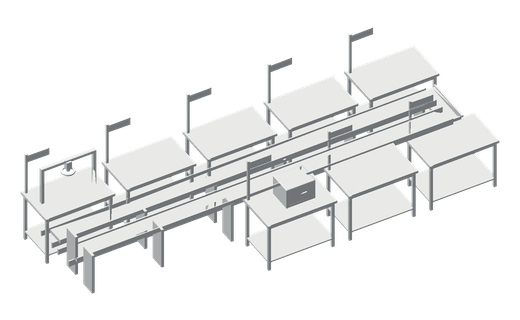
Plus One's eight-station line, rendered from its line model
Rendered from the line model
Used by
Factories, line planners
Changes when
A station is added, split or rebalanced

Open Plus One's line

II · Factory

Quality

Public

How is every unit checked, and against what limits?

Incoming inspection, in-line checks and end-of-line tests, each with what it measures, where, and its limits.

Tests
15
Inspection plans
5

test:wireless-charge

station
S8
measures
Charge current on a reference magnetic charger
lower limit
60 mA

InferredLow confidence · proposed limit

Used by
Quality teams, factories
Changes when
A limit, a test or a station changes

Open Plus One's quality

III · Lessons

Risk

Public

What could go wrong, and how badly?

Each way a step can fail, its effect and cause, scored for severity, occurrence and detection, and tied to its evidence.

Failure modes
12
Highest score
96

fm:battery-unseat

failure
Battery connector half-seated
effect
Dead unit, or resets after a drop
cause
Mate force low, no tug check
score
8 × 4 × 3 = 96

Carried over from the EC-1 lessons

Used by
Quality and reliability engineers
Changes when
A step changes, or a build finds something new

Open Plus One's risk

III · Lessons

Issues

Per record

What did go wrong, why, and what fixed it?

Each yield hitter or defect, its root cause and each fix that was tried. Each record is public, embargoed or private on its own.

On Plus One
0
On EC-1
4

EC-1 · iss:stick-drift-flux

issue
Stick drift traced to flux under the potentiometer
fix
Replace soldered pins with an FPC connector (proposed)

Plus One is not built, so it has no issues yet. EC-1 is a made-up example.

Used by
Everyone on the next build
Changes when
A build or the field finds a problem

Open EC-1's issues

III · Lessons

Variants

Per record

What change would be better, and what does it cost?

Other layouts and design changes, each scored on the same card as the original, so you can see what each one trades.

Alternatives
3

var:split-s8

change
A ninth bench takes the laser mark and the pack off S8
result
S7 and S8 then both sit at 40 s

Estimated by an agent, not built

Used by
Designers, line planners
Changes when
Someone proposes a better way

Open Plus One's variants

IV · Evidence

Sources

Public

Where did each value come from?

The build card and every source behind every value, each file pinned by its hash so you know it hasn't changed.

Sources
6

src:design-brief

kind
maker
file
docs/design-brief.md
sha256
6f0dcfc6…5cc188
Used by
Anyone checking a number
Changes when
New evidence arrives

Open Plus One's sources

IV · Evidence

Use it

Public

How do I check it, or hand it to an agent?

How to rebuild every number, a validator that checks the file, and prompts to start an agent on it.

a prompt to try

"The takt is 60 s. Which station is closest to it, and what would you change first?"

Used by
Agents, reviewers, researchers
Changes when
The tools or the rules change

Open Plus One's use it

Plus One is our own agent puck, in design. Nothing has been built, so every value above is a target.

03 · The record

Every value is a claim.

Nothing goes in without a source. Here is one real value from Plus One, taken apart.

op:ring-bond · cycle_time_s

1value
8 s
2source
inferred
3confidence
low
4evidence
src:design-brief, src:tracker-puck-spec
5note
Target from time-study estimates of similar operations
  1. The value, with its unit, so it can be summed and compared.

  2. Where it came from.

    MeasuredObservedPublic filingInferredMaker verified
  3. How sure we are. High, medium or low.

  4. The evidence, by id, each pointing at a source you can open.

  5. A note on how it was worked out. When we infer, we say so, and we ask the people who know to correct us.

How far a whole OPD has been checked

  1. ClaimedThe publisher's values, not yet checked
  2. CheckedCompared against a physical unit or the maker's own data
  3. TestedCompared against a real build

Its headline numbers carry the same badges.

Who can see it

PrivateEmbargoedPublic

An OPD is private, embargoed to a date, or public. Issues and variants can be set record by record.

04 · Updates

Every change is a version.

An OPD is a folder, kept like code. You change it, check it and publish it, and every earlier version stays.

  1. 01

    Write

    Convert your own files into a draft OPD on the hub, or edit the folder directly. An agent can draft the change for you.

  2. 02

    Check

    The validator checks the file against the schema, that every id it names exists, and that every fix marked done has its evidence.

  3. 03

    Commit

    Each upload is one commit. Files that haven't changed are skipped, and the history is kept.

  4. 04

    Publish

    A new OPD starts private. Make it public, or embargo it to a date, when you're ready.

05 · Use it

Hand it to an agent.

Every record has an id and every value a source, so an agent can answer from the file and show what each answer rests on. Try these on Plus One.

  • "The takt is 60 s. Which station is closest to it, and what would you change first?"

    Line
  • "Which risks carry over from the EC-1 lessons, and what control stops each one?"

    Risk
  • "Write the S5 work instruction for a new operator, using the SOP and the control plan."

    Assembly